SAM registration provides small businesses with critical access to federal contracts, grants, and loans without fees. This centralized system enhances visibility to government buyers, creates opportunities with prime contractors, and serves as a searchable business profile. Registered businesses demonstrate compliance readiness and gain eligibility for financial assistance programs during economic downturns. The annual renewal process maintains active status and competitive standing in the federal marketplace. Further information explores specialized benefits for various business classifications.
Financial Advantages of SAM Registration for Small Businesses

Five significant financial advantages await small businesses that complete System for Award Management (SAM) registration.
First, businesses gain access to federal contracts, grants, and loans without paying registration fees, enhancing overall financial stability.
SAM registration unlocks federal funding opportunities without additional costs, creating sustainable financial foundations for small businesses.
Second, SAM registration enables self-certification for specific programs, streamlining compliance requirements for federal transactions.
The mandatory public listing for contracts exceeding $25,000 increases visibility to potential investors and partners, creating pathways to funding diversification.
Additionally, businesses become eligible for various federal financial assistance programs, providing essential support during economic downturns.
Finally, SAM registration serves as a marketing platform, expanding market reach within the federal contracting community.
This exposure facilitates partnerships that drive revenue growth and opens doors to previously inaccessible market sectors.
Federal grant eligibility verification through SAM’s centralized database helps agencies assess the financial integrity of potential recipients.
Enhanced Competitiveness in Federal Contracting
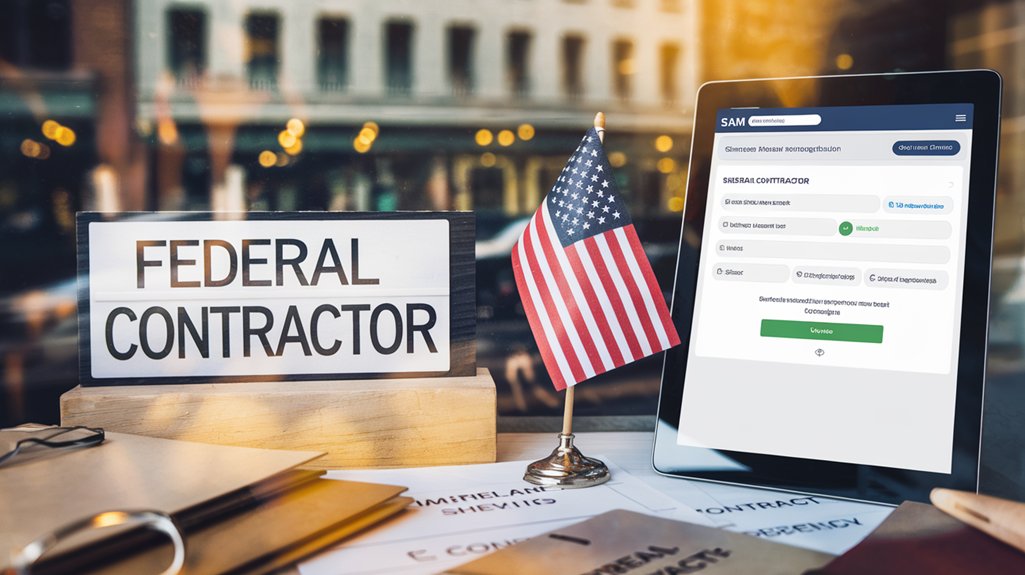
When small businesses complete their SAM registration, they gain substantial competitive advantages in the federal contracting arena. This registration guarantees government visibility, allowing contracting officers to identify and consider these businesses for procurement opportunities.
Meeting compliance requirements through SAM registration demonstrates readiness to work with federal agencies and fulfill regulatory obligations. The centralized database system helps streamline contractor information management and verification processes.
SAM-registered businesses gain access to the entire federal marketplace on SAM.gov, where they can view and bid on contracts suited to their capabilities. The system effectively filters out unqualified entities, allowing small businesses to compete only against other eligible contractors. Expert guidance and support can significantly simplify the otherwise complex registration process for small businesses entering government contracting.
Regular annual renewal of registration maintains ongoing eligibility and competitive standing in the government procurement ecosystem. These advantages position small businesses to compete more effectively for valuable federal contracts.
Streamlined Access to Government Opportunities

SAM registration provides small businesses with unparalleled accessibility to government contracting opportunities through a streamlined, centralized system. This universal portal connects businesses directly to federal procurement systems and contract platforms like SAM.gov, where billions in government contracts are posted annually.
The system enhances government visibility by functioning as a searchable business resume that contracting officers use to identify qualified vendors. With proper registration, small businesses appear in search results when agencies seek contractors with specific capabilities or locations. Annual renewal is crucial as it helps businesses maintain active status in the database and avoid service interruptions or penalties. The registration process requires obtaining a Unique Entity Identifier through SAM.gov as a mandatory prerequisite for government sales. Businesses must first secure a DUNS number before initiating their SAM registration.
SAM also facilitates contractor engagement by connecting smaller businesses with prime contractors seeking subcontractors. This creates partnership opportunities that might otherwise be inaccessible.
Through integrations with resources like the Dynamic Small Business Search and AutoConnect, SAM transforms complex government procurement into a more navigable process for small enterprises.
Frequently Asked Questions
How Long Does the SAM Registration Process Typically Take?
The SAM registration process typically takes 2-8 weeks from start to finish.
Initial processing usually requires 10-15 business days after submission, assuming all documentation is accurate.
The registration timeline can extend due to processing delays caused by errors in submitted information, technical issues, or incomplete documentation.
Businesses can minimize delays by double-checking information accuracy, preparing all required documents in advance, and considering professional assistance for maneuvering through the system’s complexities.
Can Foreign-Owned Businesses Register in SAM?
Yes, foreign-owned businesses can register in SAM.
Foreign ownership eligibility requires several specific documents, including a legal entity establishment proof, DUNS number, and NATO Commercial and Government Entity (NCAGE) code.
Registration process challenges often involve ensuring exact name and address consistency across all systems. Foreign entities must obtain their NCAGE code before initiating SAM registration.
Once registered, these businesses gain access to U.S. federal government contracts, grants, and collaboration opportunities with American companies.
What Documents Are Required for SAM Registration?
The SAM registration checklist includes several essential items of required documentation:
- Taxpayer Identification Number (TIN) or Employer Identification Number (EIN)
- DUNS Number (being replaced by Unique Entity ID)
- Banking information, including routing and account numbers
- Business address and contact information
- NAICS codes for business classification
- Notarized letter designating an authorized entity administrator
Foreign-owned businesses must also obtain an NCAGE Code before completing SAM registration.
How Often Must SAM Registration Be Renewed?
SAM registration must be renewed every 12 months. The registration expiration occurs exactly one year from the previous registration or update date.
Entities must complete their SAM renewal before this expiration to maintain active status in the federal procurement system. The renewal process requires verification and updating of business information, NAICS codes, and points of contact.
Failure to renew on time results in expiration, which prevents businesses from receiving federal contracts, grants, or payments.
Are Subcontractors Required to Register in SAM?
According to recent federal regulations, subcontractors are not required to register in SAM. However, they must obtain a Unique Entity Identifier (UEI).
While SAM registration isn’t mandatory for subcontractors, it offers significant benefits including enhanced credibility, verification of legitimacy, and potential access to more federal opportunities.
Prime contractors remain responsible for verifying that subcontractors exceeding $25,000 in contract value are not on exclusion lists before engagement.