
SAM.gov serves as the central registration portal for all federal contractors. Businesses must maintain active registration by providing their legal name, physical address, EIN, and obtaining a Unique Entity ID (UEI). The platform streamlines the contract bidding process through organized stages: sources sought, pre-solicitation, and formal solicitation. Annual renewals and accurate information are mandatory to maintain compliance status and eligibility for government opportunities. Further exploration reveals essential strategies for successfully maneuvering federal procurement regulations.
Navigating SAM.gov Registration Requirements for Federal Contractors
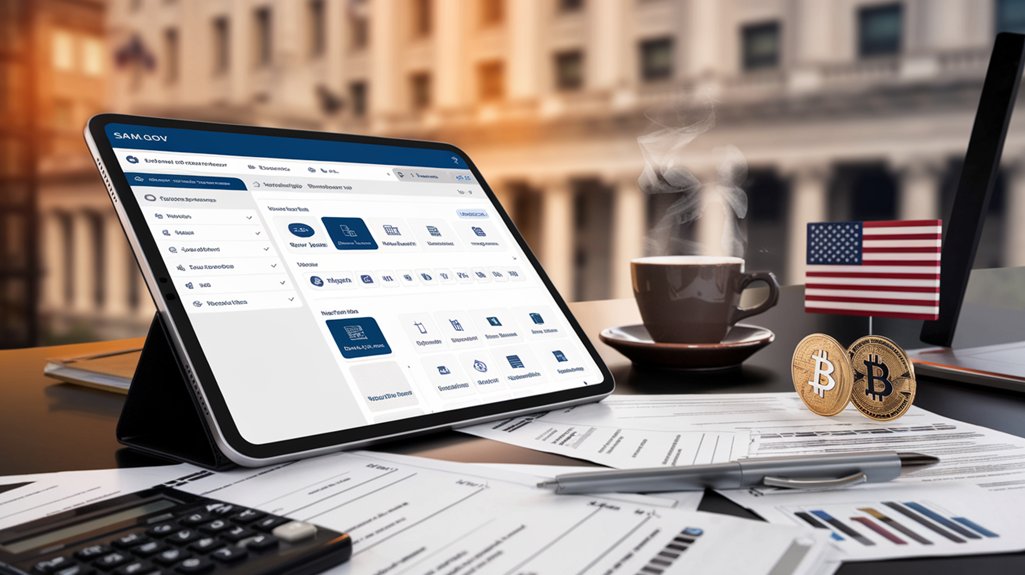
Registration in the System for Award Management (SAM.gov) serves as the critical first step for any business seeking to secure federal contracts. The process requires several key pieces of information, including the organization’s legal name, physical address, and an Employer Identification Number (EIN). Recent court rulings confirm that continuous registration requirement is enforced from the submission of a final proposal through contract completion.
The EIN importance cannot be overstated, as it validates the entity’s tax status with the IRS. Federal procurement opportunities require accurate and current information to streamline interactions with government agencies.
For certain contracts, particularly those with international components, a NATO Commercial and Government Entity (NCAGE) code becomes a necessity. This five-character identifier facilitates international transactions and must be obtained before completing SAM registration.
All registrants must now obtain a Unique Entity ID (UEI), which has replaced the former DUNS number system.
Contractors must maintain active registration throughout the entire contract period to avoid potential termination or financial penalties.
How SAM.gov Simplifies the Federal Contract Bidding Process

The entire federal contract bidding landscape has been transformed through SAM.gov’s extensive centralized platform, giving businesses unprecedented access to government opportunities. Contractors can search for contract opportunities exceeding $25,000 using specific criteria like location, contract value, and work type, streamlining their bidding strategies.
The platform organizes the bidding process into clear stages—sources sought, pre-solicitation, and formal solicitation—enabling contractors to plan their approaches methodically. This structure helps businesses prepare competitive proposals while maintaining awareness of upcoming opportunities. Successful contractors often focus on quality over quantity when selecting opportunities that align with their specific capabilities.
SAM.gov enhances market research capabilities by allowing contractors to demonstrate their qualifications during the sources sought phase. Many contractors can avoid the wasteful Death Scroll by understanding the four distinct bidding stages and targeting their efforts appropriately. Federal compliance standards are maintained through SAM’s centralized database, ensuring all registered contractors meet government regulations.
The transparency of procurement data, including past awards and competitor information, empowers contractors to develop more effective bidding strategies based on historical contract performance and agency preferences.
Maintaining Compliance and Eligibility Through SAM.gov
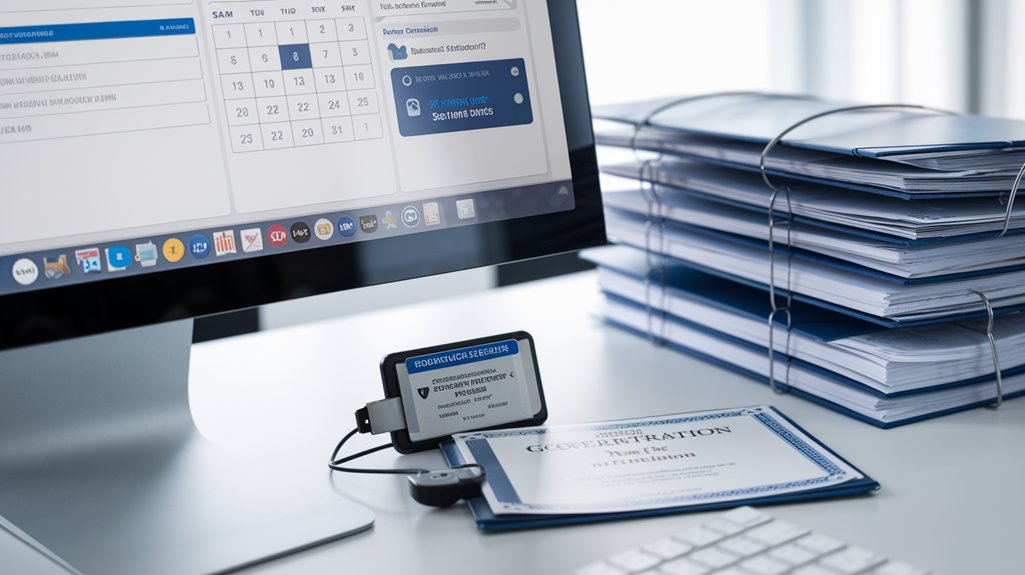
While securing federal contracts offers significant opportunities for businesses, maintaining active compliance status through SAM.gov requires ongoing attention to specific requirements and deadlines. The system serves as the primary gateway for eligibility criteria verification throughout the federal acquisition process. Active SAM registration remains valid for exactly one year from the approval date.
To maintain compliance through SAM.gov, entities must:
- Complete annual registration renewals before expiration dates to avoid interruption in contracting capabilities.
- Update entity information promptly when material changes occur, such as ownership structure or address modifications.
- Verify all certifications and representations remain current and accurate to pass compliance checks.
- Maintain thorough documentation supporting all SAM.gov registrations and claims for potential audits or verification requests.
Failure to meet these requirements can trigger suspension procedures or render an organization ineligible for federal awards. Organizations must also understand and adhere to the Federal Acquisition Regulation when participating in government contracting opportunities. Contracting officers evaluate each entity’s past performance record as part of the responsibility determination process before awarding contracts.
Frequently Asked Questions
How Long Does SAM.Gov Registration Processing Typically Take?
SAM.gov registration timeline typically spans 3-10 business days for straightforward applications.
Standard processing takes approximately three business days, but external reviews or complications can extend this period.
Processing delays commonly occur due to incomplete information, missing documentation, or high submission volumes.
In some cases, the complete registration process might extend to 2-8 weeks when including all verification steps.
Submitting accurate information and preparing all required documents in advance can help minimize potential delays.
Can Foreign Entities Register and Compete for U.S. Federal Contracts?
Yes, foreign entities can register and compete for U.S. federal contracts.
Registration requirements include obtaining a DUNS number, NCAGE code, and completing SAM.gov registration. Foreign competition in federal procurement is permitted under various trade agreements, though some contracts may have restrictions.
Foreign businesses must designate authorized representatives, guarantee legal compliance with U.S. regulations, and demonstrate financial and technical capacity.
Many international companies successfully participate in U.S. government contracting by understanding these requirements and conducting thorough market research.
What Happens if My SAM.Gov Registration Expires During Contract Performance?
When SAM.gov registration expires during contract performance, several immediate consequences occur.
The government must halt work with the contractor, potentially disrupting payments and modifications on existing contracts.
The organization becomes ineligible for new awards and disappears from federal vendor lists.
This registration lapse may trigger stop-work orders or cure notices, jeopardizing current contracts and damaging the contractor’s reputation as a reliable federal partner.
Are Subcontractors Required to Register in SAM.Gov?
Subcontractors are not generally required to register in SAM.gov for federal contracts as of 2024, according to current subcontractor regulations.
While they do need to obtain a Unique Entity Identifier (UEI), full SAM registration is primarily mandatory for prime contractors.
Prime contractors remain responsible for verifying that their subcontractors are not excluded or debarred per 2 CFR 2424.300, typically using the Excluded Parties List System for procurements exceeding $25,000.
How Do I Transfer My SAM.Gov Registration to a New Business Owner?
To transfer a SAM.gov registration to a new business owner, the current registrant must contact the Federal Service Desk (FSD) at 866-606-8220 or through FSD.gov.
The registration transfer process requires documentation verifying the business ownership change, including a notarized letter from both parties.
Both entities must provide their DUNS/UEI numbers, TINs, and legal business names.
After submission, allow 5-7 business days for processing and verification of the transfer request.