
Construction contractors must complete SAM registration to bid on federal contracts by creating a Login.gov account, obtaining a UEI number, and selecting appropriate NAICS codes. The process requires submitting accurate business information, maintaining annual renewals, and avoiding common pitfalls like expired registrations or incorrect industry codes. Contractors should prepare required documentation in advance and consider expert assistance for complex registrations. The following guide offers essential steps for successful government contractor qualification.
Essential SAM Registration Steps for Construction Contractors

The journey toward federal contracting opportunities begins with a proper SAM registration, a critical gateway for construction contractors seeking government work.
Construction professionals must first create a secure login account through Login.gov, which serves as the entry point to the SAM system.
Accessing the SAM system begins with creating a secure Login.gov account—the essential first step for construction contractors.
After establishing login credentials, contractors need to obtain their unique entity identifier (UEI), which has replaced the former DUNS number system. This identifier distinguishes the business in the federal database and is generated when creating a new SAM account.
Next, contractors must complete their core company information, including business structure, verified addresses, and detailed contact information. This profile should accurately reflect construction specialties and capabilities.
Required documentation must be gathered before starting the registration process to ensure a smooth application experience.
Remember that SAM registrations require annual renewal to maintain active status.
Construction contractors should select relevant NAICS codes that accurately represent their services when registering in SAM.
Professional guidance from experts can help construction businesses streamline this process and avoid common registration errors that could delay approval.
Selecting the Right NAICS Codes and Business Information
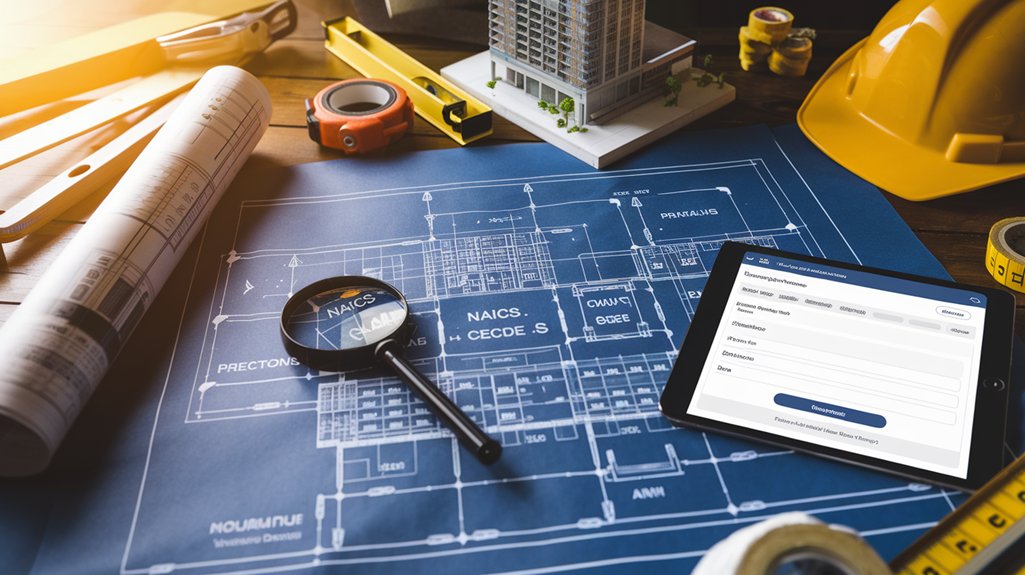
Selecting appropriate NAICS codes represents one of the most significant decisions construction contractors make during SAM registration. The NAICS classification importance cannot be overstated, as these codes determine contract eligibility and competitive positioning. Maintaining accurate code registration helps businesses stay competitive in the federal marketplace.
Construction specialists should carefully review codes such as 236115 for residential contractors or 238210 for electrical contractors before finalizing their business categorization strategies.
When selecting NAICS codes, contractors should:
- Choose primary codes that reflect at least 51% of business activities
- Include secondary codes for diversified service offerings
- Review code-specific size standards that affect contract eligibility
- Consider industry-specific codes like 238320 for painting or 238410 for drywall
Accurate NAICS selection guarantees proper classification within the federal procurement system and maximizes opportunities for construction contractors seeking government work. Construction businesses can also benefit from utilizing the SIC to NAICS Crosswalk when transitioning from older classification systems to the current standard. Specialty trade contractors typically operate as subcontractors from generals rather than managing entire construction projects.
Maintaining Compliance and Avoiding Registration Pitfalls
Why do so many construction contractors lose federal contract eligibility despite winning bids? The answer typically lies in SAM registration lapses or inaccuracies.
Construction firms must maintain active registration throughout the entire contract lifecycle—from bidding through final payment. Starting the renewal preparation process at least 60 days before expiration helps prevent processing delays and registration gaps.
Among the common mistakes contractors make is allowing registrations to expire. SAM profiles must be renewed at least two months before expiration to prevent eligibility gaps. Accurate UEI numbers are essential for proper identification in the government contracting system.
Setting registration reminders in company calendars helps avoid this pitfall.
Contractors must also update their information promptly when business details change. Outdated NAICS codes, addresses, or contact information can disqualify otherwise qualified bidders. Contractors must notify the government of any name or asset changes to ensure continued payment processing and contract eligibility.
For post-award registrations, contractors must complete the process within 30 days after award or before submitting their first invoice, whichever comes first.
Frequently Asked Questions
Can Foreign Construction Companies Register in SAM for U.S. Federal Contracts?
Yes, foreign construction companies are eligible to register in SAM to bid on U.S. federal contracts.
The registration process requires these companies to obtain a Unique Entity ID (UEI), an NCAGE code, and provide accurate physical location information.
Foreign entities must complete all documentation in English and comply with U.S. federal regulations.
Registration is free through the official SAM.gov portal and must be renewed annually to maintain eligibility for federal contracting opportunities.
How Do Joint Ventures Complete SAM Registration for Construction Projects?
Joint ventures must follow specific steps when completing SAM registration for construction projects.
They need to obtain a unique UEI number, register with a designated entity type of “joint venture,” and list all partner companies as immediate owners.
Partners must establish a written agreement beforehand that complies with SBA regulations.
The joint venture requires its own CAGE code and must maintain current registration to bid on federal construction contracts successfully.
Is SAM Registration Different for Small Disadvantaged Construction Businesses?
While the core SAM registration process is the same for all contractors, small disadvantaged construction businesses receive special small business benefits during registration.
These businesses can self-certify their socio-economic status in SAM, making them eligible for set-aside contracts and specialized programs.
The registration process includes additional questionnaires about business size, ownership demographics, and disadvantaged status that must be completed accurately to qualify for federal contracting preferences designed for disadvantaged firms.
How Long Does SAM Registration Verification Typically Take After Submission?
The SAM registration verification process typically takes 2-8 weeks to complete after submission.
Once properly submitted, registrations require approximately 10 business days to become active.
The registration timeline varies based on business structure complexity, information accuracy, and current processing volumes.
IRS and CAGE validations typically require 7-12 business days.
Regular status checks and ensuring all documentation is correct, especially notarized letters, can help prevent delays during this verification period.
Can Contractors Appeal Rejection of Their SAM Registration Application?
Yes, contractors can appeal rejections of their SAM registration applications.
The appeal process typically involves submitting additional documentation to address specific deficiencies identified during the review. Contractors should carefully review the registration requirements that weren’t met and prepare a detailed response.
Appeals are managed through the Federal Service Desk (FSD), where contractors can open a help ticket explaining their situation and providing supporting evidence to overturn the rejection decision.