SAM registration is mandatory for FEMA emergency contract eligibility. Businesses must obtain a Unique Entity ID (UEI), provide accurate Tax Identification Numbers, and maintain an active SAM.gov profile throughout the application process. Companies should opt into the Disaster Response Registry and guarantee all registration information precisely matches application details. Incomplete or inaccurate registrations can lead to disqualification. The advance contract program covers 47 mission-essential areas with pre-negotiated terms for rapid disaster response deployment.
Essential SAM Registration Steps for FEMA Contract Eligibility

Securing FEMA emergency contracts requires organizations to navigate a structured registration process within the System for Award Management (SAM.gov). This mandatory registration serves as the gateway to federal contract eligibility, requiring attention to detail throughout the process.
SAM registration challenges often arise when entities fail to maintain current information or neglect annual renewal requirements. To avoid these pitfalls, organizations must first obtain a Unique Entity ID (UEI) and guarantee their Tax Identification Number is accurate.
Federal agencies verify the eligibility and financial integrity of all potential grant recipients through this centralized database.
All application details must match the SAM registration exactly. The registration must remain active during both the application review period and at the time of award consideration.
Precise alignment between applications and SAM registration is non-negotiable throughout the entire FEMA contracting process.
Incomplete or inaccurate information can disqualify otherwise qualified applicants, making meticulous attention to registration requirements essential for successful FEMA contract eligibility.
Key Requirements for Businesses Seeking FEMA Emergency Contracts
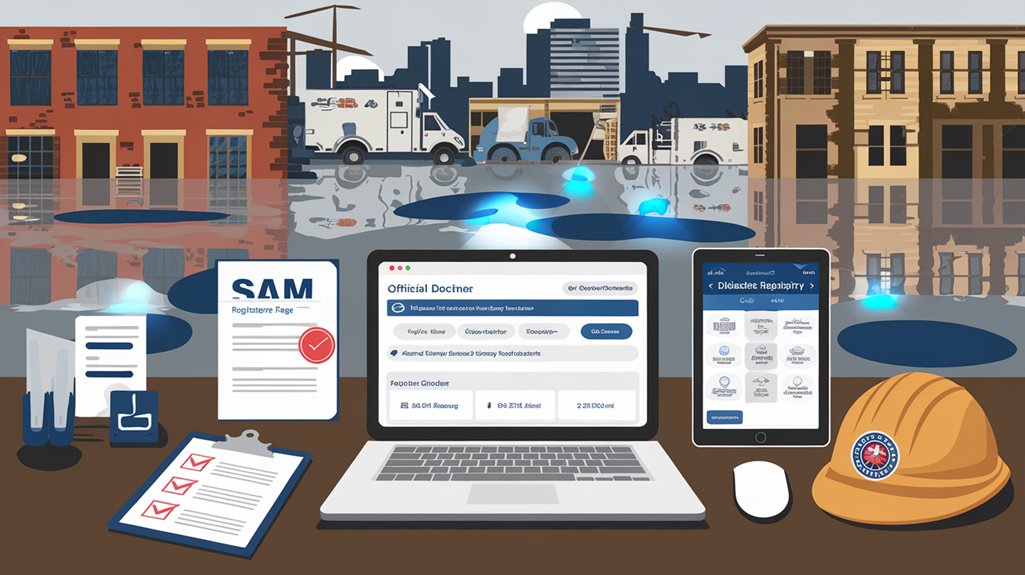
While traversing the path toward FEMA emergency contracts, businesses must satisfy several key requirements beyond basic SAM registration.
Federal procurement opportunities increase significantly for organizations maintaining active SAM.gov profiles.
Compliance guidelines mandate adherence to federal procurement standards, including socioeconomic steps and preference for domestic materials. Understanding the entity type classification is essential for properly applying the correct procurement rules and regulations.
Companies must actively opt into the Disaster Response Registry during SAM registration to become visible to FEMA contracting officers during emergencies. This critical step enables rapid identification for disaster recovery opportunities.
FEMA prioritizes businesses with:
- Local presence in affected areas
- Specialized capabilities relevant to emergency response
- Proven experience with similar disaster situations
- Ability to mobilize quickly
Businesses should leverage support resources like Procurement Technical Assistance Centers and FEMA’s Industry Liaison Program to navigate contracting complexities and enhance their competitive position for emergency contract awards.
Navigating the FEMA Advance Contract Process for Disaster Response
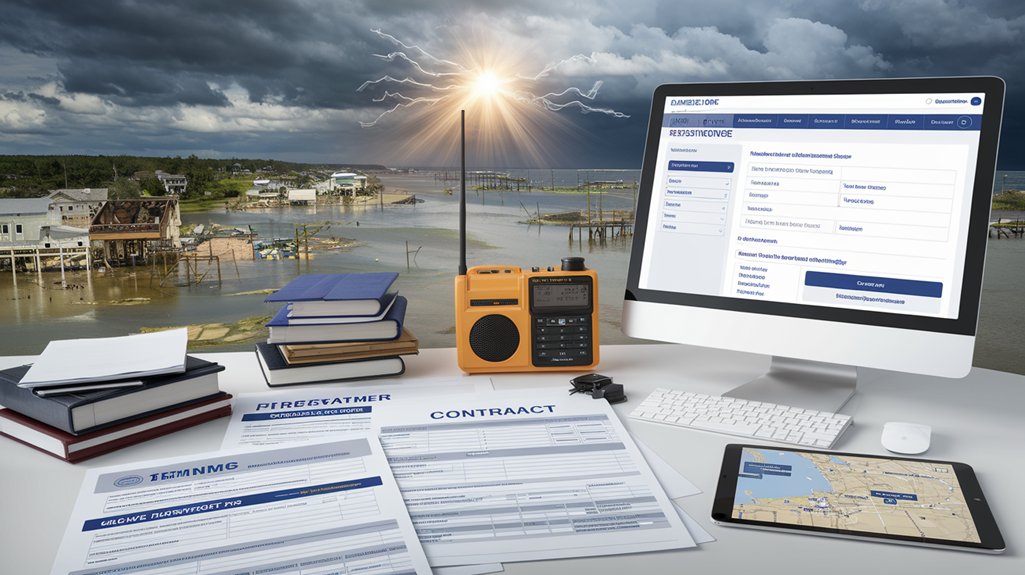
Dozens of businesses seek to participate in FEMA’s advance contract program each year, creating a competitive environment for these valuable pre-disaster agreements.
These contracts, covering 47 mission-essential areas across 102 active agreements in FY2024, enable rapid deployment of resources when disasters strike. Companies must navigate federal procurement regulations while demonstrating capacity to deliver critical services under emergency conditions. Proper documentation including notarized letters may be required during the registration process. The program emphasizes cooperative efforts between government agencies and private contractors to enhance disaster assistance effectiveness.
- Advance contract benefits include immediate mobilization upon disaster declaration, reduced administrative delays, and guaranteed service availability.
- SAM.gov registration verification is mandatory to confirm contractor eligibility and ascertain no suspensions or debarments exist.
- Procurement efficiency comes from standardized terms, centralized management, and pre-negotiated pricing that remains reasonable for market conditions.
Businesses must understand that these contracts are competed and awarded before incidents occur, not during active disaster response periods.
Frequently Asked Questions
How Long Does Fema’s SAM Registration Approval Process Typically Take?
The SAM registration timeline typically ranges from 7-10 business days for approval, though the entire FEMA contract process can extend to 2-8 weeks total.
Since the pandemic, processing times have increased from the previous 8-10 day average.
Preparation takes approximately 45 minutes, but completing the full application may require over 10 hours.
Accurate information submission and business structure complexity are key factors affecting approval duration.
Can Foreign-Owned Businesses Qualify for FEMA Emergency Contracts?
Foreign-owned businesses can qualify for FEMA emergency contracts under specific contract conditions.
While FEMA prioritizes U.S. entities, foreign eligibility exists through proper System for Award Management (SAM) registration, obtaining a Unique Entity ID, and joining the Disaster Response Registry.
However, these businesses face challenges including geographic set-asides for disaster-affected areas and preference for local contractors.
Emergency acquisition flexibilities may occasionally permit foreign participation, particularly for operations outside the United States or during urgent situations.
What Insurance Coverage Levels Are Required for FEMA Contractors?
FEMA contractors must maintain specific insurance requirements based on contract scope. These typically include:
- General liability coverage of $1-2 million per occurrence
- Vehicle liability insurance meeting state minimums
- Workers’ compensation as required by state law
- Professional liability coverage for service providers
Contractor liability requirements increase for high-risk projects. Coverage must remain active throughout the contract period, with FEMA often requiring proof of insurance before contract award and during performance.
Are There Special Considerations for Minority-Owned Businesses Seeking FEMA Contracts?
Minority-owned businesses seeking FEMA contracts enjoy several advantages, including access to set-asides and sole-source contracts.
Many face certification challenges when proving 51% minority ownership and control.
FEMA offers funding opportunities through special programs designed to promote diversity in disaster recovery efforts.
Businesses must complete certification through recognized agencies to qualify for these benefits.
The certification process requires substantial documentation, but provides competitive advantages in securing government contracts during disaster response initiatives.
Can Subcontractors Work on FEMA Projects Without SAM Registration?
Subcontractor eligibility for FEMA projects is contingent upon SAM registration.
While subcontractors may perform work under prime contractors, they cannot formally participate in or receive direct federal awards without being registered in SAM.
Prime contractors typically enforce this requirement through flow-down clauses in subcontracts.
For long-term or official subcontractor relationships on FEMA projects, SAM registration is mandatory.
Without it, subcontractors risk contractual validity issues and may face disqualification from federal project participation.