
SAM registration requires accurate representations and certifications of business status, capabilities, and compliance with federal regulations. Companies must complete mandatory data fields, obtain unique identifiers, and submit truthful declarations about socio-economic classifications. Annual renewals are essential, with updates needed when business circumstances change. Designating trained points of contact and implementing quarterly compliance checks helps maintain eligibility for federal contracts. Proper SAM management prevents disqualification and payment issues throughout the procurement process.
Annual SAM Registration Certifications: What You Need to Know

The System for Award Management (SAM) registration process forms a critical foundation for any entity seeking to conduct business with the federal government. This certification process requires several essential components, including socio-economic status declarations and assertions confirming regulatory compliance.
Entities must provide accurate information during registration, particularly when claiming specific business designations such as Women-Owned or Veteran-Owned status. The Small Business Administration verifies small business classifications as part of this process. The Representations and Certifications section ensures businesses meet all legal and regulatory requirements for federal contracting. Maintaining active status in SAM is essential for businesses pursuing government contracts and requires regular updates to prevent registration expiration.
The registration timeline typically spans several weeks, from initial submission through final approval. Businesses must submit formal representations about their capabilities and status, followed by a thorough review period. Federal award eligibility may be suspended if entities fail to complete their annual renewal requirements on time.
Expect a multi-week registration journey requiring formal submissions before government approval is granted.
To maintain compliance, registrants must renew annually, update points of contact, and guarantee all documentation remains current, particularly TIN information and notarized authorization letters.
Navigating Compliance Requirements in the SAM System

Successful registration in the System for Award Management requires organizations to navigate a complex array of compliance requirements that form the foundation of federal contracting eligibility.
The entity registration process begins with obtaining a unique entity identifier, which serves as the cornerstone for verification in the SAM system. Organizations must complete all mandatory data fields, including Commercial and Government Entity (CAGE) codes and Electronic Funds Transfer indicators. Before beginning registration, businesses should obtain a DUNS number to ensure proper identification within the system.
The unique identifier verification process guarantees that contractors can receive payments and participate in federal opportunities. Contracting officers validate this information prior to award, unless specific FAR clauses provide exemptions. Maintaining accurate SAM records is essential as payment issues can arise when information is outdated or incorrect.
Entities must update their registration annually to maintain compliance, as failure to do so can result in exclusion from federal contracting opportunities.
Best Practices for Maintaining Accurate Representations in SAM
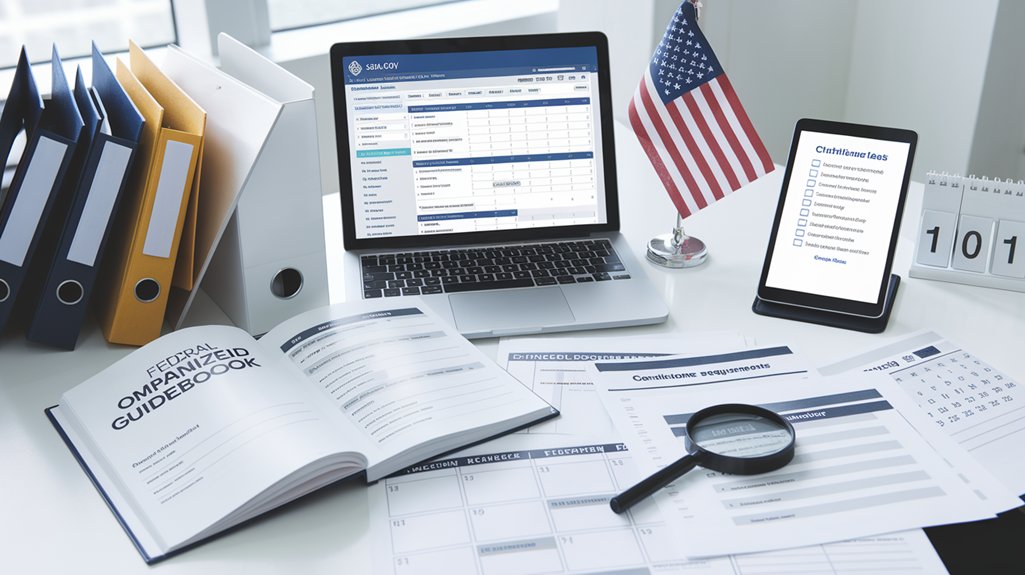
Maintaining accurate representations within the System for Award Management requires diligent attention to detail and consistent monitoring practices that support long-term compliance. Organizations must establish systematic approaches to guarantee registration accuracy throughout the validity period of their SAM profile.
Precision and vigilance in SAM registration maintenance safeguards organizational compliance and contracting eligibility.
Effective maintenance practices include:
- Scheduling quarterly compliance checks to verify all representations and certifications remain current with business operations and federal regulations.
- Implementing a dedicated review process before annual renewal to compare existing representations against actual business practices and capabilities.
- Documenting all changes to representations with supporting evidence, guaranteeing audit readiness and maintaining a clear trail of updates.
When inaccuracies are identified, immediate corrections prevent potential disqualification from federal opportunities and maintain eligibility for contracts. According to recent GAO decisions, companies must be vigilant about their registration status to avoid costly disqualifications, even for single-day lapses.
This proactive approach safeguards an organization’s standing within the federal procurement system. Required disclosures must be truthfully reported to prevent potential penalties and maintain federal contracting eligibility. Designating trained Points of Contact for SAM management ensures consistent oversight and timely updates when business circumstances change.
Frequently Asked Questions
Can Foreign Entities Register in SAM for U.S. Government Contracts?
Yes, foreign entities can complete SAM registration to compete for U.S. government contracts.
This process requires obtaining a Unique Entity Identifier (UEI) and NATO Commercial and Government Entity (NCAGE) code. Foreign organizations must guarantee their business information matches exactly across all documentation systems.
While registration is free, entities must comply with U.S. federal laws and may need to obtain a U.S. Taxpayer Identification Number.
Annual renewal is necessary to maintain eligibility for federal opportunities.
What Happens if I Miss My Annual SAM Renewal Deadline?
Missing a SAM renewal deadline has immediate and significant consequences. The entity becomes ineligible for federal contracts and grants, resulting in removal from SAM searches and inability to bid on new opportunities.
Renewal penalties may include payment delays for existing contracts or potential termination. The organization faces financial risks through lost revenue opportunities and operational disruptions.
To rectify this situation, entities should apply for renewal immediately to restore eligibility and prevent further complications.
Are Small Businesses Exempt From Any SAM Certification Requirements?
Small businesses are not exempt from SAM registration requirements. All businesses seeking federal contracts must register in SAM, regardless of size.
While small businesses do self-certify their status during registration, this represents a streamlined process rather than an exemption from certification requirements. They must still accurately report their business information, maintain annual updates, and use correct NAICS codes.
Size standards compliance remains mandatory to qualify for small business set-aside contracts and other federal opportunities.
How Do I Update My Business Size Classification Mid-Year?
To update a business size classification mid-year, a company must log into their SAM account and navigate to the “Representations and Certifications” section.
There, they can modify their employee count or annual revenue figures that determine their size status. This classification update should be completed within 30 days of a significant change in business size.
Companies should guarantee accurate information is provided, as misrepresentation may result in penalties or loss of contract eligibility.
Can Subcontractors Bypass SAM Registration if Prime Contractors Are Registered?
Yes, subcontractors can legally bypass SAM registration requirements when working under prime contractors who are already registered in SAM.gov.
While subcontractor registration is not mandatory for federal subcontracts, it remains a recommended practice for increasing visibility to potential prime partners.
Prime contractor obligations include ensuring project compliance with federal regulations regardless of their subcontractors’ registration status.
This arrangement allows subcontractors to participate in federal projects without the administrative burden of maintaining SAM registration.