Registering under the wrong purpose in SAM.gov can trigger severe consequences, including contract termination, payment delays, and potential debarment from federal contracting. Common errors stem from business classification mistakes, NAICS code selection issues, and documentation inconsistencies. To correct errors, businesses should contact the Federal Service Desk, update their SAM.gov profile with accurate information, and implement regular compliance audits. Proper understanding of registration purposes and verification procedures will greatly reduce future registration complications.
Understanding the Consequences of Incorrect Purpose Registration

When businesses register in the System for Award Management (SAM) with an incorrect purpose designation, they face potentially severe legal, financial, and operational repercussions.
These registration implications extend beyond simple administrative corrections and can jeopardize current and future contract eligibility.
The legal ramifications may include criminal and civil penalties for providing false information to the federal government.
Agencies may reject bids, terminate existing contracts, or withhold payments until registration errors are corrected.
In severe cases, entities may face suspension or debarment from federal contracting activities.
Companies must recognize that purpose registration errors affect eligibility for specific solicitations and set-asides, particularly those designated for small or disadvantaged businesses.
The costs of rectifying these errors often include legal fees, administrative burdens, and potential business opportunities lost during the correction process.
Regular compliance audits should be implemented to ensure ongoing information integrity and prevent situations that could trigger investigations by federal authorities.
Recent case law, including the Myriddian, LLC decision, has established that even a temporary lapse in SAM registration during proposal evaluation can result in mandatory disqualification from contract consideration.
Maintaining accurate UEI validation through regular verification processes is crucial for preserving federal compliance and preventing registration errors.
Common Scenarios Leading to Purpose Registration Errors
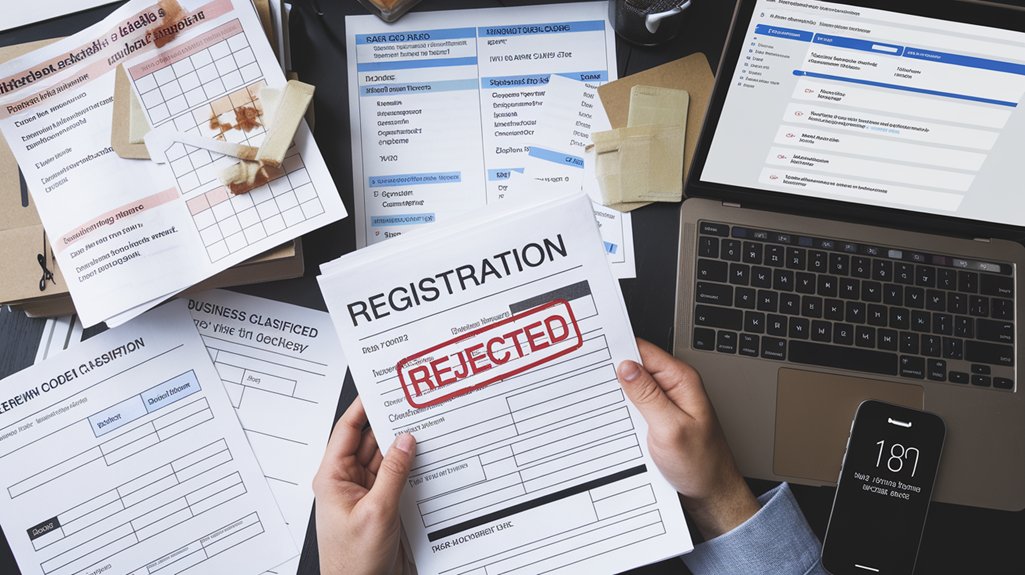
Numerous businesses encounter SAM registration complications due to purpose designation errors, which stem from several common scenarios.
Business classification errors frequently occur when companies incorrectly self-certify as small disadvantaged businesses or misinterpret affiliation requirements, affecting over 120,000 registrations nationwide. DUNS number verification is another critical prerequisite that organizations often overlook during the registration process.
Documentation challenges represent another significant obstacle, with rejections commonly resulting from missing signatures, expired documents, or incorrect file formats.
Additionally, inconsistencies between entity information and banking details often trigger verification failures.
NAICS code selection presents particular difficulties, as companies either choose codes that don’t align with their actual operations or fail to update codes when business activities evolve.
Maintenance issues compound these problems when organizations miss annual renewal deadlines or neglect to update critical business information during the renewal process. The SAM system frequently rejects applications due to mismatched data when information in the registration doesn’t align with IRS and Dun & Bradstreet records.
How to Correct and Prevent Purpose Registration Mistakes

Correcting purpose registration mistakes requires a systematic approach that addresses both immediate errors and establishes preventive measures for future submissions.
Organizations should begin by contacting the Federal Service Desk (FSD) for technical assistance, then update their SAM.gov profile with accurate purpose information. The registration process should include thorough error verification through the Entity Validation Service. Remember that entity validation is essential for preventing improper payments and procurement fraud during the registration process. Browser compatibility can significantly impact validation processing, so ensure your system meets all technical requirements.
To prevent future mistakes, businesses must clearly understand the different registration purposes available in SAM.gov. Regular audits of registration data can identify discrepancies before they cause problems.
Verifying the legal business name and ensuring Dun & Bradstreet records match SAM information are essential preventive steps. Companies handling complex registrations should consider consulting with specialists who understand federal procurement requirements to navigate the process successfully.
Frequently Asked Questions
Can a Foreign Entity Register Under Domestic Business Purposes?
Foreign entities cannot register under domestic business purposes in SAM. This misrepresentation creates foreign registration implications that violate federal regulations and invalidates the registration.
For domestic business eligibility, foreign organizations must register according to their actual foreign status. The legal structure must align with U.S. federal regulations, and all entity information must match exactly across DUNS, NCAGE, and SAM databases.
Foreign entities must follow proper registration procedures for their specific circumstances.
What Happens if SAM Registration Lapses During Contract Performance?
When SAM registration lapses during contract performance, contractors face serious registration consequences. Contractors become ineligible for payment processing, violate FAR 52.204-7 requirements, and risk contract termination.
The government must enforce this requirement strictly, with no exceptions for minor lapses. Contractors remain responsible even if renewal was submitted before expiration but processing was delayed.
This can disrupt cash flow and jeopardize current and future business opportunities with the government.
Are Small Businesses Exempt From Certain SAM Registration Requirements?
Small businesses are generally not exempt from SAM registration requirements.
All businesses seeking government contracts must register in SAM, regardless of size. While there are no broad exemptions specifically for small businesses, limited waivers exist under the nonmanufacturer rule for specific product categories where small business manufacturers are unavailable.
These class waivers, issued by the SBA, apply to particular product categories rather than providing blanket exemptions from the registration process itself.
How Do Joint Ventures Handle Purpose Registration in SAM?
Joint ventures must register in SAM as distinct entities with their purpose specifically aligned to federal contracting activities.
This registration must reflect the JV’s intent, whether bidding on contracts or receiving awards.
Joint venture obligations include selecting the correct purpose during registration and ensuring all member information is properly documented.
The purpose selected should match the JV agreement terms and the specific federal procurement activities the venture plans to pursue.
Can Purpose Registration Errors Affect Past Performance Ratings?
Yes, purpose registration errors can affect past performance ratings.
Incorrect purpose designations in SAM have significant performance implications, potentially leading to contract ineligibility or termination. These registration consequences are documented in contractor evaluation databases, where contracting officers may note compliance failures.
When agencies review past performance for future awards, these errors appear as risk factors. Maintaining accurate SAM purpose designations is essential for preserving positive performance ratings and securing future contract opportunities.