
Missing mandatory attachments in SAM registration causes significant problems, including application rejection, delayed verification processes, and lost contract opportunities. Required documents typically include certified incorporation articles, utility bills for address verification, and EIN documentation from the IRS. Businesses face reduced visibility in government procurement systems when documentation is incomplete. Systematic organization of required attachments through thorough checklists and pre-submission verification protocols can prevent these costly registration delays. Further exploration reveals additional strategies for ensuring submission success.
Essential Attachments Required for Successful SAM Registration

Documentation forms the foundation of a successful System for Award Management (SAM) registration process. The verification process requires specific document types that authenticate a business entity’s legal identity, physical location, and tax information.
Critical attachments include certified copies of articles of organization or incorporation that validate the legal business name and entity type. For address verification, utility bills requiring credit verification serve as acceptable proof, while bank statements may be used if appropriately redacted.
Certified organizational documents establish legitimacy, while verified utility bills or redacted bank statements confirm physical presence.
Taxpayer identification verification requires IRS-issued EIN documentation or IRS confirmation letters. Organizations must also submit evidence of entity type through formation certificates or stock certificates. It’s important to note that SAM registration is now mandatory for all contracts exceeding $30,000 that are awarded to vendors operating outside the United States.
A notarized letter may be required for certain registration types to validate the entity’s information. Entities should avoid submitting unacceptable documents such as screenshots from government systems, self-generated documents, or rental agreements, as these will result in registration rejection during verification.
How Missing Documents Impact Federal Contract Eligibility and Timeline
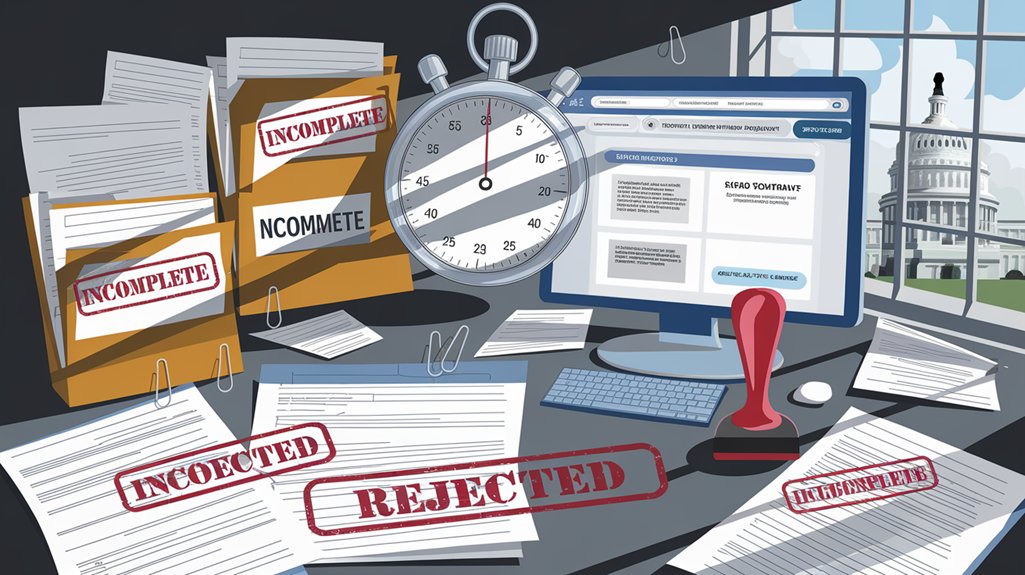
When critical attachments are missing from a System for Award Management (SAM) registration, businesses face significant obstacles in their pursuit of federal contracts and grants. The document verification process becomes prolonged, with review periods extending several weeks beyond normal timelines.
Missing mandatory attachments often result in registration rejection, requiring complete resubmission and further delaying eligibility confirmation. Companies experience reduced visibility within the system, limiting their attractiveness to government clients and restricting access to valuable opportunities like SBIR grants and federal contracts. The absence of a notarized letter can be particularly problematic as it’s essential for validating the entity’s legitimacy and preventing fraudulent registrations. Seeking assistance from experienced third-party services like GSE can help businesses avoid these common registration errors and omissions.
The consequences extend to business operations, as incomplete documentation can challenge socio-economic status verification, diminish competitiveness in the federal marketplace, and necessitate additional resource allocation. Federal funding ineligibility can severely impact an organization’s ability to participate in government opportunities.
For many businesses, these delays translate directly to missed financial opportunities and stunted growth potential.
Practical Solutions for Avoiding Attachment-Related Registration Delays

Maneuvering the attachment requirements for SAM registration represents a critical step for businesses seeking federal contracts. Proper document organization before beginning the registration process can dramatically reduce delays and rejections.
Entities should establish a systematic approach to gathering, validating, and preparing all necessary attachments.
A methodical system for document collection and validation forms the backbone of successful SAM registration submissions.
- Create a document checklist – Develop a thorough list that includes TIN verification documents, formation certificates, and notarized administrator letters with specific spaces to track certification status.
- Implement a pre-submission verification process – Review each document against SAM requirements, ensuring all information matches exactly what was entered in the registration system.
- Establish submission troubleshooting protocols – Prepare backup procedures for addressing common upload issues, including alternative file formats and compression methods for oversized documents.
Maintaining an active SAM registration status is essential for continued eligibility to pursue government contracts and grants.
Frequently Asked Questions
Can International Entities Upload Documents in Non-English Languages?
International entities may submit documents in non-English languages, but must include certified English translations.
The translation requirements specify that both original and translated versions must be attached to submissions.
All translations must be certified as accurate and complete by a translator who is fluent in both languages.
This document translation process guarantees compliance with U.S. federal, state, and local laws while maintaining the integrity of important business information during SAM registration.
How Do Tribal Entities Submit Unique Cultural Authority Documentation?
Tribal entities submit unique cultural authority documentation through formalized processes established by the Bureau of Indian Affairs. This submission includes extensive evidence of continuous tribal existence, distinct cultural patterns, and political authority.
Tribal documentation requirements typically encompass historical records, tribal rolls, affidavits from elders, and evidence of land occupation spanning at least 50 years.
Cultural authority verification often requires multiple forms of evidence that demonstrate the tribe’s distinct identity and continuous community existence.
What Happens if My Appointment Letter Signatory Leaves the Organization?
When a signatory leaves an organization, the entity’s SAM registration may face challenges during future updates.
The organization should promptly initiate a new appointment process to designate another individual with proper signatory authority. This requires submitting a new notarized letter on company letterhead to the Federal Service Desk.
To maintain registration continuity, organizations should plan ahead by having multiple authorized signatories and establishing clear succession protocols for administrative responsibilities.
Are Digital Signatures Acceptable on Appointment Letters and Legal Documents?
Digital signatures are acceptable on appointment letters and legal documents under current digital signature regulations.
The ESIGN Act grants them the same legal status as handwritten signatures in the United States. For appointment letter validity, organizations must guarantee their digital signature process includes proper authentication and security measures.
Government agencies widely accept digital signatures, which streamline document processing while maintaining compliance with legal standards for document authentication and integrity.
Can Contractors Update Attachments Without Restarting the Validation Process?
No, contractors cannot update attachments without restarting the validation process in SAM.gov.
Once a registration is submitted, the system requires complete resubmission to process any changes, including attachment updates.
The validation process treats all registration components as a single unit that must be verified together.
Contractors should guarantee all mandatory attachments are correctly uploaded before submission to avoid delays associated with restarting the entire validation sequence, which may take several weeks to complete.