
SAM account lockouts occur when multiple failed login attempts trigger security protocols. To resolve these issues, check security logs for Event ID 4740, review cached credentials in Windows Credential Manager, and examine mobile devices with outdated login information. Clear expired credentials, update mapped drive configurations, and review scheduled tasks using authentication details. Implementing least privilege principles and conducting regular access audits greatly reduces lockout incidents. The following solutions offer all-encompassing approaches to managing these disruptive security events.
Understanding SAM-Related Account Lockout Mechanisms

When a Windows system needs to protect user accounts from unauthorized access attempts, it relies on the Security Account Manager (SAM) database’s lockout mechanisms. These mechanisms trigger account lockout after a predetermined number of failed login attempts within a specific timeframe. Similar to Federal Acquisition Regulations, the SAM database enforces strict security protocols to maintain system integrity.
The SAM database, located within the Windows registry, stores local user credentials and enforces password policies set by administrators. For example, a standard configuration might lock an account after 10 failed attempts within 10 minutes, with automatic restoring access after 10 minutes of inactivity.
Lockout events generate security logs, such as Event ID 4740, which provide critical information about the locked account and the source computer. This notification system helps administrators identify potential brute force attacks while maintaining security without permanently disabling legitimate user access. However, when dealing with privileged accounts, the SAM database sometimes experiences resource errors that prevent proper lockout functionality, especially with built-in Administrator accounts. Prior to October 2022 updates, built-in Administrator accounts were not subject to lockout policies, creating significant security vulnerabilities.
Troubleshooting Windows Profile Lockouts: Causes and Solutions
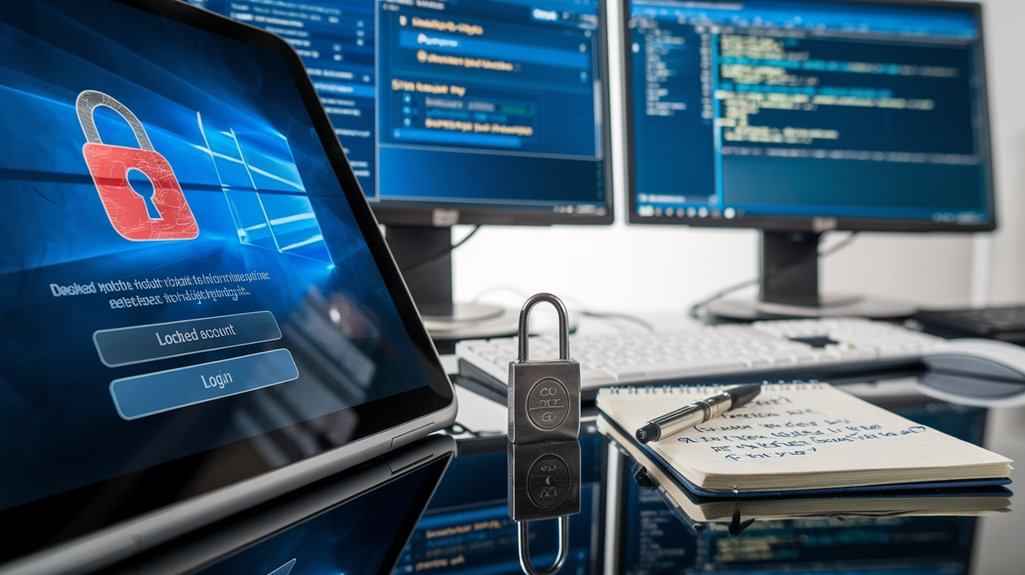
Profile lockouts in Windows environments frequently frustrate both users and administrators, disrupting workflow and productivity across organizations. Common causes include credential caching in Windows Credential Manager, outdated mapped drives, applications using expired credentials, and scheduled tasks with obsolete authentication details. Accounts typically remain locked for 30 minutes before automatic unlocking occurs when using default settings.
Administrators should systematically troubleshoot lockouts by examining the PDC Emulator’s security logs, specifically focusing on Event ID 4740 for account lockout incidents. Mobile devices with outdated credentials are often overlooked as significant contributors to persistent account lockouts. Similar to obtaining a DUNS number for SAM registration, proper credential verification is essential for system access. Effective lockout monitoring requires reviewing Events 466 and 4625 to pinpoint failing authentication attempts.
PDC Emulator security logs reveal the true story behind account lockouts through critical Events 4740, 466, and 4625.
Immediate remediation involves clearing cached credentials, updating network drive configurations, revitalizing application authentication settings, and modifying scheduled tasks.
Organizations can prevent recurring lockouts through regular credential audits, active security log monitoring, user education, and automated detection tools that identify credential conflicts before they trigger lockouts.
Enhancing Security While Preventing Unnecessary Administrator Lockouts

Balancing robust security measures with administrative functionality presents a core challenge for IT departments managing authentication systems. Organizations must implement strong password complexity requirements while guaranteeing administrators maintain necessary system access.
Implementing least privilege principles greatly reduces lockout risks by limiting administrative actions to only what’s required for specific roles. Regular access audits help identify potential vulnerabilities before they cause lockouts. Establishing clear Role-Based Access Control (RBAC) frameworks guarantees administrators have appropriate permissions without excessive privileges. Preventing sAMAccountName spoofing attacks is essential when configuring access controls to protect against identity-based security breaches. Similar to federal grant systems, maintaining active system registration and verification is crucial for ongoing administrative access. Enabling User Account Control limits applications from running with administrative rights and provides an additional security layer against unauthorized privilege escalation.
To further prevent lockouts while maintaining security, organizations should:
- Create separate administrative accounts for daily tasks versus privileged operations
- Document password recovery procedures before implementing stricter policies
- Establish secure password storage solutions for emergency access
- Conduct regular reviews of administrator accounts to verify appropriate access levels
Frequently Asked Questions
Can SAM Errors Bypass Account Lockout Policies Completely?
SAM errors typically cannot bypass account lockout policies completely.
However, resource-related issues, such as disk failures, may prevent the proper recording of failed login attempts. This can create security implications where lockout mechanisms fail to activate as intended.
Built-in Administrator accounts have special considerations, as they’re not locked out by default.
Organizations should monitor system resources and event logs to identify bypass methods that could unintentionally circumvent lockout protections during system failures.
How Do Offline Attacks Against SAM Differ From Online Lockout Scenarios?
Offline attacks against SAM databases bypass security measures that typically protect systems during online scenarios.
While online login attempts face account lockout policies, rate limiting, and network constraints, offline attacks occur on extracted password hashes using specialized hardware.
Attackers with offline access can make billions of password guesses per second without detection, compared to online scenarios where each failed attempt is logged and potentially triggers lockout mechanisms after multiple failures.
Does Virtualizing Windows Systems Affect SAM Lockout Functionality?
Virtualizing Windows systems does not fundamentally alter SAM lockout functionality. The security policies that govern account lockouts continue to operate as designed within virtual machines.
However, resource constraints in virtualized environments, such as storage I/O bottlenecks, can potentially interfere with proper SAM database operations.
Standard lockout policies, event logging, and security mechanisms remain intact, with virtualization adding a layer of isolation without changing the core lockout mechanics.
Are Cloud-Synced Accounts Subject to the SAMe SAM Lockout Mechanisms?
No, cloud-synced accounts are not subject to the same SAM lockout mechanisms as local accounts.
These accounts operate under different cloud security protocols established by providers like Azure AD. While local Windows accounts use SAM database rules, cloud-synced accounts follow separate lockout policies configured in their respective cloud environments.
Account synchronization between local and cloud systems maintains separate security boundaries, with each following its own lockout thresholds and duration settings.
What Impact Do Hardware Security Modules Have on SAM Lockout Behaviors?
Hardware Security Modules (HSMs) do not directly alter SAM lockout behaviors, but they enhance the security ecosystem around them.
Through hardware encryption, HSMs protect authentication credentials and cryptographic keys from unauthorized access. Their robust access control mechanisms reduce the likelihood of brute-force attacks that trigger lockouts.
While HSMs add security layers to authentication processes, the fundamental SAM lockout policies remain governed by the operating system’s security settings.