U.S. entities receive CAGE codes through SAM registration while international organizations must obtain NCAGE codes through NATO Codification Tool before SAM registration. Both codes serve as unique identifiers for government procurement and consist of five characters. International entities must secure NCAGE codes prior to SAM.gov access, while U.S. businesses receive CAGE codes automatically during SAM registration. Understanding these distinct processes guarantees smoother participation in federal contracting opportunities.
Understanding CAGE vs. NCAGE: Key Differences for U.S. and International Entities

When maneuvering government contracting systems, entities must understand the distinct identification codes required based on their geographical location. The primary distinction lies in their regional application: CAGE Codes are specifically designated for U.S.-based entities, while NCAGE Codes serve international organizations outside American territories. Complete registration accuracy is crucial for successful code assignment and federal procurement participation.
Both codes maintain a five-character format and fulfill the same fundamental purpose—providing standardized identification for government procurement processes. However, they differ in their registration procedures. U.S. entities obtain CAGE Codes through the System for Award Management (SAM), whereas international entities must apply for NCAGE Codes via the NATO Codification Tool. This process is essential as non-U.S. businesses must secure their NCAGE Code before they can proceed with SAM.gov registration and UEI assignment. The DLA Customer Interaction Center offers direct assistance to entities struggling with the registration process through email or phone support.
Understanding these differences is essential for compliance with procurement requirements. U.S. contractors need CAGE Codes, while international vendors require NCAGE Codes before completing SAM registration for U.S. government contracts.
Step-by-Step Registration Process: Navigating CAGE/NCAGE Requirements in SAM
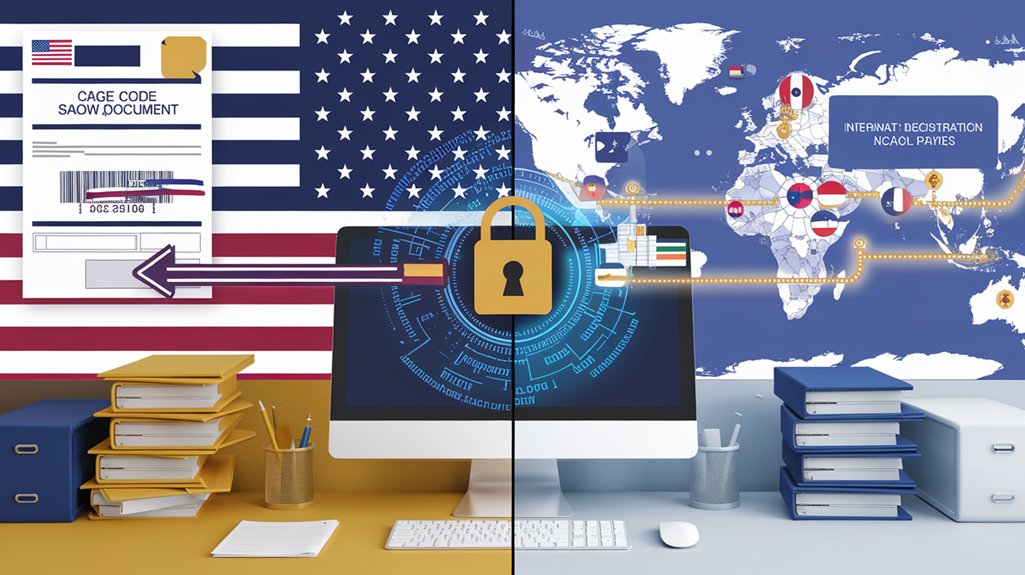
The registration process for obtaining CAGE or NCAGE codes through the System for Award Management (SAM) involves several critical steps that entities must complete accurately to secure government contracts.
This process differs based on registration categories, with U.S. organizations receiving CAGE codes automatically during SAM registration, while international entities must obtain NCAGE codes beforehand through the NSPA ePortal.
Documentation requirements include gathering legal business names, physical addresses, tax identification numbers, and banking information.
For international entities, supporting validation documents are particularly important. Entities not seeking financial assistance from DoD may be exempt from the NCAGE requirement.
After submitting the appropriate paperwork, entities should monitor communications from SAM.gov or NSPA, responding promptly to verification requests.
Most registrations activate within 3-5 business days, requiring annual updates to maintain compliance and eligibility for federal awards.
Entities must ensure their application includes a proper physical business address since virtual locations and PO boxes are not accepted as valid addresses in the SAM registration process.
Understanding common registration pitfalls can help businesses avoid unnecessary delays and streamline their application process for government contracting.
Common Pitfalls and Solutions When Obtaining Your Entity’s CAGE/NCAGE Code

Steering the CAGE and NCAGE code acquisition process presents several challenges that can delay or complicate government contracting opportunities.
Among the common mistakes, international entities often attempt SAM registration before obtaining their required NCAGE code, causing application rejections.
Inaccurate address information represents another frequent pitfall, as physical address verification is essential for code assignment.
Registration tips include ensuring data accuracy during SAM registration and addressing country-specific NCAGE requirements.
For U.S. entities, remember CAGE codes must be renewed every five years if obtained after August 26, 2016.
International companies should prepare for varying processing times, with routine NCAGE requests taking longer than emergency ones.
Regular monitoring of email notifications and prompt responses to information requests from the Defense Logistics Agency will greatly streamline the process.
Companies seeking international contracts should understand that NATO Support Agency handles all NCAGE registrations for non-U.S. entities.
Entities must have a valid EIN number before beginning the CAGE code application process.
U.S. businesses should note that CAGE codes are assigned at no cost to the entity during the SAM.gov registration process.
Frequently Asked Questions
How Long Do Cage/Ncage Codes Remain Valid Before Renewal?
U.S.-based CAGE codes issued after August 26, 2016 remain valid for five years before requiring renewal.
The CAGE code validity period is calculated from the date of the last update received by the CAGE program.
In contrast, NCAGE codes for international entities currently do not have set expiration dates.
CAGE code expiration can be prevented through timely SAM registration renewal, which automatically updates and extends the linked CAGE code’s active status.
Can Parent Companies Share CAGE Codes With Subsidiaries?
Parent companies cannot share CAGE codes with subsidiaries. Each entity within a corporate structure must maintain its own unique CAGE code for government contracting purposes.
This separation guarantees proper accountability and compliance with regulatory requirements.
Subsidiary responsibilities include obtaining and managing their individual CAGE codes, even when performing work related to the parent company’s contracts.
The GAO has rejected proposals where a subsidiary’s CAGE code was incorrectly used to meet solicitation requirements.
What Happens to My CAGE Code During Company Relocation?
When a company relocates, the CAGE code typically remains unchanged if the legal entity status remains the same.
The company must update its address information in the SAM registration system to reflect the new location. This company address update should be completed promptly, as contractors must notify contracting officers of any changes within 30 days.
CAGE code relocation procedures only require a new code if the legal entity structure changes during the move.
Are Cage/Ncage Codes Transferable During Mergers or Acquisitions?
During mergers or acquisitions, CAGE codes are transferable through a formal novation process.
This CAGE code transfer requires both entities to submit detailed documentation, including bills of sale and certificates of merger. The novation agreement transfers contract obligations to the successor company, ensuring continuity of government contracts.
Merger implications include updating SAM registration information and ensuring proper entity verification. Companies must notify relevant government agencies about the changes to maintain compliance with federal regulations.
How Quickly Are Cage/Ncage Codes Assigned After Application Submission?
CAGE code assignment typically occurs within 4-5 business days after SAM application approval for US-based entities.
The application processing timeline for international entities seeking NCAGE codes follows a similar timeframe through the NSPA e-portal.
After assignment, notification is sent via email to the designated point of contact.
The codes then appear in relevant systems, such as CAGE Search and Inquiry (CSI), within 1-10 business days after processing.